
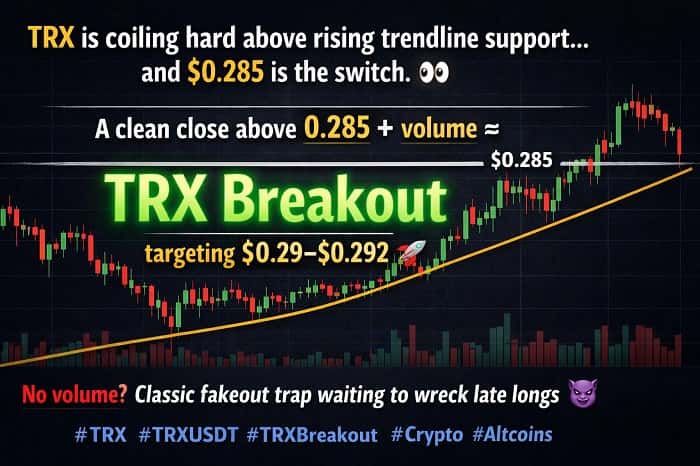
TRX Breakout: The Quiet Setup That Could Explode Above $0.285
TRX Breakout spotliht after a sharp drop—yet the chart is no longer screaming panic. Instead, it’s doing something traders love and fear at the same time: compressing. With price holding around $0.2794 USDT and respecting a rising trendline, the market is quietly building pressure for a TRX Breakout that could surprise late sellers.
This is the kind of structure that looks “boring” right before it turns fast. Higher lows, repeated bounces off dynamic support, and a clear pivot at $0.285 are combining into a classic coil. If buyers step in with real volume, the next TRX Breakout attempt could drive a clean push into the $0.29–$0.292 zone. For momentum traders, this TRX Breakout is all about timing and confirmation.
Why the Chart Looks Calm Right Before It Moves
When a coin drops hard, the first question is whether the sell-off is finished or just pausing. The most useful clue is not a single candle—it’s the behavior afterward. In this case, the post-drop behavior is constructive: price is holding above an ascending trendline and printing higher lows. That’s often the foundation for a TRX Breakout, because it shows demand is willing to pay slightly higher prices on each dip.
Compression matters because it represents agreement. Sellers aren’t able to force price back below support, and buyers aren’t yet strong enough to clear the ceiling. As the range tightens, the market stores energy. Once that balance breaks, the move can be sharp, especially when the breakout level is obvious and widely watched.
Trendline Support: The Floor That Keeps Getting Tested
The most important element in this setup is the dynamic, rising trendline support, currently estimated around $0.274–$0.276. Each time price tags this zone and rebounds, it reinforces the idea that buyers are defending it. This repeated defense is what turns a simple bounce into a credible TRX Breakout setup.
However, trendline support is not magic—it’s a battleground. The more often it’s tested, the more information you get, but also the more vulnerable it can become if buyers run out of ammo. That’s why the quality of the next bounce (strong candles, quick reclaim, rising volume) matters as much as the level itself.
The $0.285 Pivot: One Number, Two Stories
The market is currently compressing beneath a key pivot: $0.285. This is not just a random line on a chart. It’s a decision point where supply has recently shown up, and where short-term traders will likely place stops, entries, and take-profit orders.
A clean close above $0.285 is the trigger that turns “possible” into “actionable.” In other words, it’s the moment the TRX Breakout becomes validated rather than imagined. Without that close, the coin can keep chopping, trapping impatient longs and rewarding disciplined waiting.
What confirmation looks like is straightforward: a decisive candle body closes above $0.285 (not just a wick), the next candle or session shows follow-through, and volume expands meaningfully versus the prior compression range.
If those pieces align, the market is saying: buyers have absorbed the sell pressure, and the path of least resistance is up.
Also watch how price behaves around the level after the close: strong breakouts tend to hold above the pivot, while weak ones drift back into the range and churn.
Volume Isn’t a Bonus—It’s the Proof
In breakout trading, volume is the receipt. Price can poke above resistance on low participation and then fade instantly. That’s why volume confirmation is central to this idea. A TRX Breakout supported by increasing volume suggests the move is powered by real demand, not just thin liquidity or stop-hunting spikes.
If volume does not expand, treat the breakout as “unconfirmed.” Unconfirmed breakouts are where traders get chopped: they enter on the first push, price reverses, and the market retests support with everyone suddenly nervous. Waiting for volume may feel slow, but it often saves you from the most common breakout mistake—entering the fake one.
Targets: Where the Market Might Take Profits
If $0.285 flips from resistance into support, the next obvious area is the $0.29–$0.292 resistance band. This zone is close enough to attract momentum buyers but also close enough to trigger quick profit-taking. For a TRX Breakout, that’s exactly the kind of first target that can be hit quickly, followed by either a continuation or a pullback.
A practical way to think about the path is simple: first a break above $0.285 with volume, then (often) a retest toward $0.285 to confirm it holds, and finally a push into $0.29–$0.292 where sellers may defend again.
If price stalls at $0.29, that’s not “failure”—it’s normal market behavior. The first resistance after a breakout is where the market checks whether momentum is real or just initial excitement.
A Simple Trade Plan (Without Guessing the Top)
The highest-probability approach is to build a plan around confirmation and invalidation. Here’s a clean framework that many traders use for a TRX Breakout scenario. If you miss the first thrust, a second-chance TRX Breakout entry can appear on the retest.
Entry idea:
-
Conservative: wait for a confirmed close above $0.285 and enter on a retest.
-
Aggressive: enter on the breakout candle with strict risk control and volume confirmation.
Invalidation idea:
-
If price closes back below the pivot after breaking it, the breakout is suspect.
-
A deeper invalidation is a clear break below trendline support (~$0.274–$0.276), which would weaken the higher-low structure.
Profit management:
-
Consider partial profit into $0.29–$0.292.
-
If momentum is strong, trail a stop below higher lows to stay in the move.
The goal isn’t to predict. It’s to respond when the market shows its hand.
What Could Ruin the Setup Overnight
Every good setup has a point where it stops being good. For this structure, the warning signs are straightforward: a decisive breakdown below the rising trendline support, a failure to hold $0.285 after a breakout (a quick reclaim by sellers), or broad market weakness that drags majors and alts lower simultaneously.
Because TRX often moves with wider crypto sentiment, keep an eye on Bitcoin’s direction and liquidity conditions. In a risk-off swing, even a technically clean TRX Breakout can fail as traders rotate to safety.
The Bigger Context: Why This Matters in “Altcoin Season” Talk
Traders love the phrase “altcoin season,” but the market doesn’t reward narratives—it rewards timing and structure. This is why the current TRX Breakout setup is interesting: it’s not based on hype. It’s based on a visible trendline defense and a clear trigger level. When enough traders can agree on the same levels, moves can accelerate quickly once the trigger is hit.
At the same time, the most dangerous trades happen when everyone expects an easy rally. That’s why confirmation and volume are essential. Let the market prove itself before you commit size.
Bottom Line
TRX is holding above rising trendline support near $0.274–$0.276 and compressing beneath the $0.285 pivot. If buyers can produce a confirmed close above $0.285 with expanding volume, the TRX Breakout thesis gains real traction and the $0.29–$0.292 resistance zone becomes the logical next objective.
Until that confirmation arrives, patience is a position. Watch the pivot, watch the trendline, and let volume decide whether the next TRX Breakout is real—or just another trap.