
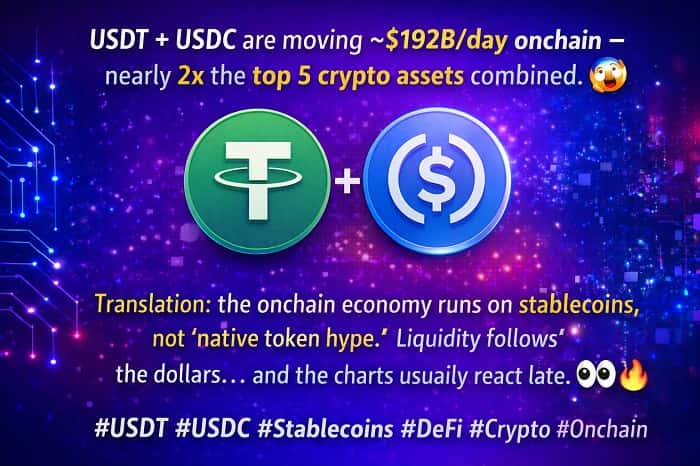
Stablecoin Onchain Volume: The $192B Daily Clue That Outsmarts the Charts
Stablecoin Onchain Volume is quietly becoming crypto’s most important statistic. USDT and USDC now push about $192B per day onchain—nearly twice the combined volume of the top five crypto assets. That single datapoint should reshape how you interpret “adoption,” “liquidity,” and even the timing of risk-on rotations. Price headlines scream. Settlement flow whispers. And right now, the whisper is louder than the candles.
Most traders still treat stablecoins as a parking lot. In reality, they’re the highway. Every spot purchase, perp margin top-up, cross-exchange arbitrage loop, and DeFi rebalance tends to touch stablecoins somewhere in the path. When Stablecoin Onchain Volume expands, it’s often because the market is moving value with intention—not just marking up prices.
Boring Coins, Violent Implications
The “boring” assets have a habit of driving the biggest structural changes. Stablecoins remove volatility from the unit of account, which makes them usable for payments, treasury planning, and collateral management. That’s why Stablecoin Onchain Volume tells a different story than native-token trading volume. Native tokens often reflect speculation. Stablecoins often reflect function.
Here’s the uncomfortable truth: the onchain economy doesn’t need your favorite L1 to be a store of value to be useful. It needs a reliable medium for settlement, quoting, and liquidity routing. Stablecoin Onchain Volume is the scoreboard for that usefulness.
Why USDT and USDC Own the Rails
USDT and USDC dominate because they sit where crypto actually transacts: centralized exchange order books, OTC desks, perps collateral, and DeFi pools. Network effects do the rest. The more venues list them, the more users rely on them; the more users rely on them, the tighter the spreads; the tighter the spreads, the more volume concentrates.
This is also why Stablecoin Onchain Volume often scales faster than token activity during “quiet” markets. Traders may hesitate to buy volatility, but they still rotate risk, move collateral, and settle trades. Stablecoins are the tool for that.
Payments Didn’t Die—They Got a New Skin
For years, crypto payments struggled: volatility made pricing messy, and fees made small transfers painful. Stablecoins changed both. Merchants can invoice in dollars, freelancers can get paid without FX drama, and cross-border transfers can settle faster than traditional rails.
If you want a practical read on whether crypto is becoming a utility, watch stablecoin transfer activity. Utility creates repetitive behavior. Repetitive behavior creates consistent throughput. Consistent throughput creates network gravity.
DeFi Runs on Dollars, Not Dreams
DeFi’s real product is instant liquidity. Stablecoins are the base collateral that lets users borrow, lend, LP, hedge, and rebalance without constantly touching fiat rails. Even when token prices chop sideways, DeFi can remain busy because risk management still requires movement.
That’s why Stablecoin Onchain Volume can rise while charts look sleepy. Capital doesn’t always announce itself with a pump. Sometimes it prepares. Sometimes it hedges. Sometimes it shifts to where the next opportunity will be cheapest to execute.
What the $192B Figure Really Implies
A daily number that large implies more than speculation. It implies operational usage: exchanges netting flows, market makers rebalancing inventory, protocols moving collateral, and payment apps settling transactions. It also implies that stablecoin liquidity is becoming the default “blood type” of onchain activity.
In other words, Stablecoin Onchain Volume is not just a metric—it’s evidence that the settlement layer is scaling faster than the narrative layer. Traders arguing about which token “wins” miss the bigger move: dollars are already winning onchain.
The Institutional Reason This Hits Different
Institutions don’t love volatility. They love predictable reporting, stable purchasing power, and clean accounting. Stablecoins offer that, while still enabling onchain settlement speed. That doesn’t mean institutions instantly trust every issuer or every chain—but it does mean the entry point is obvious.
Rising stablecoin settlement throughput makes the market more legible to professional capital. It tightens execution, lowers friction, and makes it easier to operate without taking unwanted exposure. That’s not hype. That’s workflow.
How This Rewrites a Trader’s Playbook
If stablecoins dominate throughput, then “liquidity conditions” are increasingly stablecoin conditions. You can think of stablecoins as the market’s dry powder and its settlement engine at the same time.
When Stablecoin Onchain Volume expands alongside increasing derivatives participation, moves often follow through because collateral is actively circulating. When Stablecoin Onchain Volume expands while spot prices stall, it can hint at positioning, rotation, or accumulation—money moving into place before risk is expressed. When stablecoin flow contracts sharply, liquidity can thin out and rallies can fail from lack of fuel.
The Risks People Conveniently Forget
Stablecoins add efficiency, but they also add concentration. A few issuers and a handful of dominant rails can become systemic chokepoints. Banking relationships, redemption mechanics, and regulatory pressure matter. If a market relies heavily on one issuer, one chain, or one set of venues, resilience is lower than it looks.
So treat Stablecoin Onchain Volume as a “traffic report,” not a guarantee. Heavy traffic means usage. It doesn’t automatically mean safety.
Multi-Chain Liquidity Is a Stablecoin Story
Stablecoins don’t pick sides. They migrate to cheaper fees, better UX, deeper liquidity, and faster settlement. As bridges and rollups mature, stablecoin liquidity becomes more portable, and competition between ecosystems intensifies.
That portability makes Stablecoin Onchain Volume a broader measure of the entire onchain economy, not just one chain’s community. If stablecoin flow shifts, activity can shift with it—sometimes quickly.
The Next Wave: Stablecoin-First Design
More apps are being built with stablecoins as default inputs and outputs: trading interfaces, remittance tools, payroll products, and DeFi strategies. This design choice makes pricing predictable and reduces friction for users who don’t want to think in volatile units.
As that trend spreads, Stablecoin Onchain Volume becomes less of a headline and more of a baseline. The question won’t be “Are stablecoins important?” It will be “Which rails capture the settlement, and who monetizes the flow?”
What to Watch Before the Next Surge
If you’re trying to trade this shift instead of just admiring it, focus on three things. First, distribution: are flows spreading across multiple chains or bottling up in one place? Broad distribution usually signals healthier demand and more resilient liquidity. Second, velocity: is activity accelerating because of frequent smaller transfers, or because of a few massive settlements? High velocity often means retail and application usage; big blocks often mean venues and professionals rebalancing.
Third, conversion points: pay attention to moments when stablecoins move onto exchanges, out of exchanges, or into lending markets. Those transitions often precede volatility in risk assets because they represent intent changing form—parking to deploying, deploying to hedging, hedging to exiting. You don’t need perfect data to benefit; you need a consistent lens and the patience to wait for confirmation in price action after the flows shift. Over time, these signals help you separate real liquidity from loud narratives. In markets driven by speed and leverage, the side that understands settlement behavior usually reacts first—and pays less for entries.
Final Take
Stablecoin Onchain Volume is the clearest sign that onchain activity is maturing into a settlement network. With USDT and USDC moving around $192B per day, stablecoins are increasingly the engine of payments, liquidity routing, and collateral mobility. If you’re trying to understand where real usage lives—and when the market is quietly preparing to move—Stablecoin Onchain Volume is the number you should be watching.