
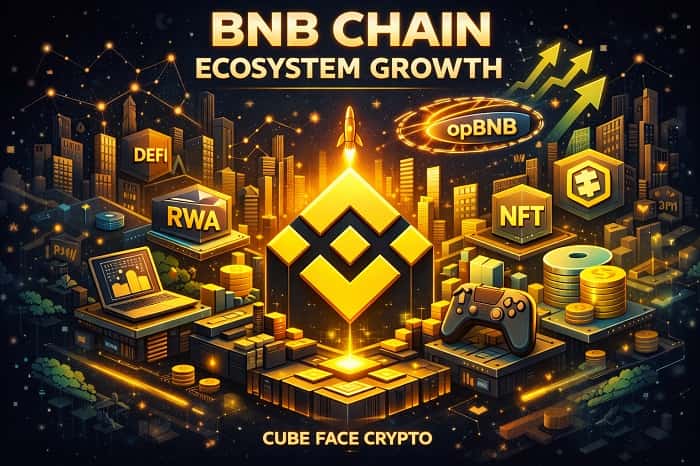
BNB Chain ecosystem growth in numbers
BNB Chain ecosystem growth, it helps to start with raw usage data: daily active users, transaction counts and DeFi liquidity. BNB Chain’s own weekly ecosystem reports regularly show millions of daily active addresses on BNB Smart Chain (BSC), with over 100 million transactions processed in a single week and tens of billions of dollars in cumulative trading volume.
Independent research backs this up. Analytics from 2025 highlight record user numbers and around $17 billion in DeFi total value locked (TVL) across the BNB ecosystem, suggesting that liquidity is not just speculative hot money but increasingly sticky capital across lending, DEXs and yield platforms.
On the market side, BNB itself has outperformed many large-cap peers over the last year, with some analyses noting triple-digit percentage gains versus still-strong but lower returns for Bitcoin and Ethereum. That performance has been strongly correlated with on-chain activity spikes and fee growth on BNB Chain rather than just centralized-exchange trading.
The picture that emerges is a chain where user activity, DeFi TVL and network revenue are moving in the same direction. That alignment is a key reason why BNB Chain growth continues to command attention from funds, treasuries and retail traders alike.
From DeFi and memecoins to RWAs and stablecoins
BNB Chain’s first big wave came from DeFi “blue chips” and high-yield farms, but the current BNB ecosystem looks much broader. Recent ecosystem reviews describe a transition from “hyper-growth” to “ecosystem deepening,” where traffic is distributed across:
-
DeFi protocols (DEXs, lending, liquid staking)
-
Memecoins and speculative tokens
-
Stablecoin infra and payment rails
-
RWA experiments and yield-bearing tokenization
This diversification matters for BNB Chain ecosystem growth. When activity is concentrated in one vertical (for example a single DEX farm season), it can collapse as fast as it appeared. By contrast, BNB Chain’s current mix spreads user demand across trading, savings-like products, payments and pure speculation.
Memecoins arguably played the role of “on-ramp” for many new users in 2025, driving enormous transaction counts and on-chain buzz. But behind the noise, stablecoin and RWA projects are building more durable use cases around remittances, savings and tokenized collateral. That shift from one-shot speculation to recurring financial flows is a sign of an ecosystem moving closer to real-world utility.
opBNB and the multi-layer architecture
A major pillar of BNB Chain ecosystem growth is its scaling stack. BNB Smart Chain remains the core EVM-compatible base layer, but the launch of opBNB, an optimistic rollup-style Layer 2, gives the ecosystem a way to handle far higher throughput while keeping fees extremely low.
opBNB is designed specifically for high-volume use cases like gaming, social dApps and hyperactive DeFi. By batching and compressing transactions off-chain and then settling them back to BNB Chain, it offers:
-
Lower average fees than the already-cheap base layer
-
Higher transaction throughput for micro-transactions and in-game actions
-
A more modular architecture where new L2s can plug into the same BNB liquidity base
For builders, this architecture means they can start on BSC for simplicity, then migrate high-volume components to opBNB without abandoning the BNB ecosystem. For users, the existence of both BSC and opBNB simply looks like fast confirmations and barely noticeable gas costs.
From a strategic perspective, opBNB positions BNB Chain as not just a single chain, but as a multi-layer Web3 platform capable of hosting consumer-scale apps. That’s crucial if BNB Chain wants to sustain its current user metrics without hitting performance bottlenecks.
Governance, decentralization and regulatory overhang
The growth story around BNB Chain is intertwined with ongoing debates about decentralization and regulation. BNB Smart Chain is often described as a permissioned, validator-capped network, with validator selection controlled through a Beacon Chain and a relatively small set of block producers compared to Ethereum or some newer L1s.
At the same time, Binance and its leadership have faced years of regulatory scrutiny and enforcement actions across multiple jurisdictions. US authorities, in particular, have pursued cases around money laundering controls, licensing and sanctions violations, culminating in large fines and leadership changes
For the BNB Chain ecosystem, this creates a double-edged dynamic:
-
Upside: Binance’s resources, brand and user base funnel liquidity and developers into BNB Chain, accelerating adoption.
-
Risk: Legal or regulatory shocks can spill over into market perception of BNB and projects building atop the chain.
Institutional users and serious DeFi teams now tend to look closely at validator decentralization, on-chain governance transparency and Binance’s separation from BNB Chain’s technical roadmap. Ecosystem growth is more likely to sustain if the chain can demonstrate credible independence in decision-making while still benefiting from Binance’s distribution.
Builders, tooling and developer experience
Under the hood, BNB Chain ecosystem growth is also a story about developer experience. By choosing an EVM-compatible design early and keeping gas costs low, BNB Chain ended up as a natural second home for Ethereum-native projects looking for cheaper execution and a huge retail user base.
Key ingredients that attract builders include:
-
Familiar Solidity and EVM tooling, making migrations straightforward
-
Strong wallet support via MetaMask, Trust Wallet and others
-
A dense network of DEXs, bridges and oracles already integrated
-
Launchpad and incubation programs associated with the broader Binance stack
Hackathons, grants and ecosystem funds continue to push new experiments in gaming, AI-driven dApps and social tokens. Many teams adopt a multi-chain strategy: they deploy on Ethereum or another L1 for credibility, and on BNB Chain for user acquisition and transaction-heavy features.
From a CubeFace Crypto lens, the interesting shift is that BNB Chain is moving from “fork-and-farm” protocols to more original IP: native games, NFT brands and infra services that are born on BNB first, then expand outwards.
How media and analytics like CubeFace Crypto track BNB Chain
As BNB Chain has scaled, so has the need for fast, data-driven coverage. CubeFace Crypto positions itself as a crypto and Web3 newsroom delivering quick, verified headlines and concise takes across markets, DeFi and regulation, with on-chain analysis baked in.
For readers following BNB Chain ecosystem growth, that kind of coverage is crucial in a few ways:
-
Surfacing early signals from weekly ecosystem reports and on-chain dashboards
-
Contextualizing TVL spikes or fee surges (memecoin mania vs. genuine adoption)
-
Flagging regulatory developments that may affect BNB and BNB-based projects
Longer-form magazine pieces on CubeFace.com can then zoom out from the headline cycle. Instead of a single TVL milestone, they look at trend durability, cross-chain flows, where “smart money” is rotating, and how BNB Chain compares to competitors in the same market phase.
Beyond CubeFace, BNB and BNB Chain both maintain detailed entries on reference sites like Wikipedia, alongside coverage on major crypto analytics and research portals. These provide historical context on the token’s origins, tokenomics and past controversies, while media outlets and specialized dashboards handle the real-time story.
Final words
BNB’s evolution from exchange discount token to backbone of a multi-layer smart-contract network shows how quickly narratives can flip in crypto. BNB Chain ecosystem growth is now driven by millions of daily users, billions in DeFi liquidity, and a scaling roadmap that includes opBNB and other modular components.
The bull case is clear: a low-fee, high-throughput chain with a massive funnel from Binance and an increasingly diverse mix of DeFi, gaming, memecoins and RWAs. The bear case is equally real: regulatory pressure on Binance, ongoing questions around validator decentralization, and the ever-present risk that users rotate to trendier chains.
For now, the data points to an ecosystem that is not just growing, but maturing. For traders, builders and long-term investors, staying on top of BNB Chain ecosystem growth — through on-chain metrics and specialized media like CubeFace Crypto — will be key to spotting both opportunities and risks early.
Frequently asked questions about BNB Chain ecosystem growth
1. Is BNB Chain still dependent on Binance, or is it becoming more independent?
BNB Chain clearly benefits from Binance’s enormous user base, liquidity and brand, and that connection remains a core growth driver. At the same time, it is maturing into its own Web3 platform with independent developer communities, scaling solutions like opBNB, and a growing roster of native projects that are not directly tied to the exchange.
2. How does BNB Chain compare to other major L1s for DeFi and gaming?
BNB Chain tends to sit near the top of the charts for daily active users and transaction counts, often rivaling or surpassing larger ecosystems when memecoin or gaming cycles hit. Fees are typically lower than on Ethereum mainnet, and the EVM-compatible environment makes it easier to port DeFi protocols and games, though some competitors may offer stronger decentralization or more experimental virtual machines.
3. What should investors watch to gauge whether BNB Chain growth is sustainable?
Beyond BNB price, it’s important to monitor metrics like active addresses, transaction counts, and DeFi TVL over multi-month periods, not just short-term spikes. The share of activity coming from long-term products (stablecoins, RWAs, lending) versus pure speculation is another key signal, as are governance improvements, validator diversification and any major regulatory developments that could impact Binance or BNB.
Short summary for CoinMarketCap profile:
BNB Chain has evolved into a high-throughput Web3 ecosystem powered by BNB, with millions of daily users, multi-billion-dollar DeFi TVL, and scaling solutions like opBNB driving low-fee activity across DeFi, gaming, memecoins and RWAs, even as the network balances rapid growth with ongoing decentralization and regulatory challenges.