UNI Burn Mechanism: How Uniswap Just Turned UNI Into a Deflationary Monster
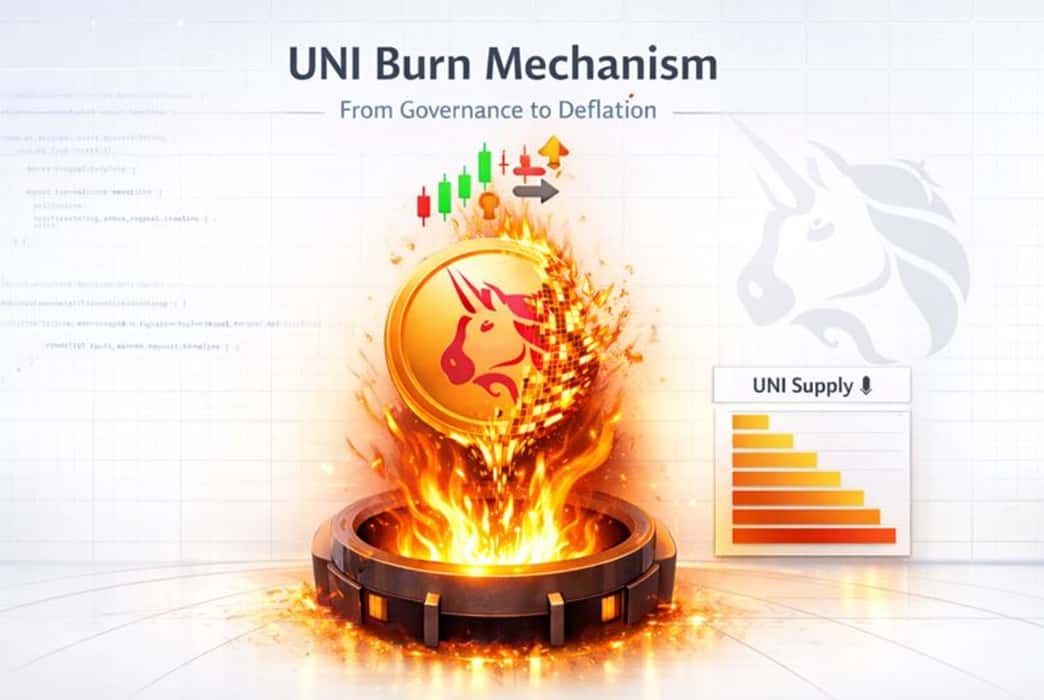
UNI Burn Mechanism Uniswap has pushed a lot of boundaries over the years, but this time it went straight for the core of its own token. The UNI Burn Mechanism is the biggest structural change UNI has ever seen, turning it from a mostly “harmless” governance token into something that actually behaves like a scarce, value-linked asset. With the UNI Burn Mechanism live, UNI is no longer just about voting and vibes — it’s tied directly to protocol usage, fees, and volume in a way that can’t be ignored.
At its core, the UNI Burn Mechanism flips the script that has haunted governance tokens for years: “Why should this be worth anything?” Instead of hand-waving about future utility, Uniswap has baked a direct economic loop into the token. The more people trade, LP, and settle on Uniswap and its L2 stack, the more UNI is burned and removed from circulation.
1. From harmless governance token to deflationary asset
For a long time, UNI was powerful in governance but weak in hard economics. It decided rules, fee switches, and upgrades — but tokenholders had no direct, mechanical claim on protocol cash flow. That narrative broke in late December 2025, when Uniswap activated the UNIfication proposal and, in the same breath, made the UNI Burn Mechanism the new backbone of UNI’s tokenomics.
Uniswap didn’t just talk about burning; it opened with a hammer: 100 million UNI — roughly 600 million USD at the time — permanently destroyed from the foundation’s reserve. That wasn’t just optics. It was framed as “back pay” for seven years where the protocol didn’t capture fees at the token level. Overnight, the total treasury shrank dramatically, and the message was clear: UNI supply is no longer untouchable.
2. How the burn actually works
This isn’t a random, occasional burn. The UNI Burn Mechanism taps into multiple ongoing revenue streams and routes them toward one destination: permanent supply reduction.
On Ethereum mainnet, Uniswap now diverts roughly 16–25% of the fees that LPs generate in v2 and major v3 pools into what’s been branded the Firepit — an automated burn engine. Instead of every unit of fee revenue being purely paid out to LPs, a slice is captured and used to buy and burn UNI, tightening supply over time.
Then you have the L2 angle. With Unichain — Uniswap’s own L2 — the design goes a step further. Around 85% of sequencer fees, after operational costs, are used to continuously buy back and burn UNI from the market. In other words, Unichain doesn’t just expand the ecosystem; it extends the UNI Burn Mechanism beyond mainnet and into a higher-throughput, lower-fee environment where usage could scale far faster.
3. Daily burns, volume, and market psychology
Because the UNI Burn Mechanism runs continuously, it introduces a new rhythm to UNI: every day that Uniswap is used, a little more supply disappears. Right now, that translates into thousands of UNI being burned daily — for example, roughly 4,000 UNI in a single day, or about $24.9K worth at recent prices. That number will fluctuate, but the key point is this: as long as people trade, burn pressure exists.
Narratively, this is huge. In past cycles, UNI would spike mainly on big announcements — UniswapX, v3, v4, L2 news — and then slowly bleed once the hype faded. Now, whenever traders ape into volatility and volume explodes, the UNI Burn Mechanism quietly hits the accelerator in the background. The hotter the market, the more aggressively UNI gets retired. That’s the kind of feedback loop that can make narratives stick in a bull environment.
4. The road here: UniswapX, Unichain, v4, UNIfication
This deflation shift didn’t come out of nowhere. It’s the culmination of a multi-year product arc:
-
July 2023: UniswapX is announced, pointing toward more advanced order routing and RFQ-style execution.
-
October 2024: Unichain (L2) goes live, giving Uniswap its own scaling environment instead of relying purely on external rollups.
-
January 2025: Uniswap v4 launches, leaning into hooks, custom pools, and more flexible AMM infrastructure.
-
December 2025: UNIfication activates, and with it, the full UNI Burn Mechanism design.
Each of these upgrades expanded what Uniswap could do. The latest one ties all of that back into the token. The UNI Burn Mechanism is effectively the “economic bridge” between protocol growth and UNI’s long-term scarcity.
5. What deflation actually means for UNI
“Deflationary” gets abused a lot in crypto, so it’s worth being precise. If Uniswap’s fee flows and Unichain’s sequencer revenue stay strong or grow, the UNI Burn Mechanism scales with them. That means net supply can trend downward, even as demand cycles up and down. There’s no guarantee price rises in a straight line — but the math behind ownership changes.
If trading volume grows, the UNI Burn Mechanism scales with it; more usage means more UNI destroyed, which increases the share of the remaining supply in any future upside. Instead of depending on constant new token incentives or unchecked emissions, the system shifts toward a model where active usage reduces the pie while holders keep their slice.
At the same time, the UNI Burn Mechanism permanently reduces the “option value” of the treasury. Burning 100 million UNI up front shrank Uniswap’s war chest by nearly $600M. That’s less ammunition for future incentives or grants, but it also sends a strong signal that tokenholders aren’t just the dilution target — they’re directly benefiting from protocol-level choices.
6. Risks, trade-offs, and what could go wrong
No mechanism is magic, and this one isn’t either. If activity dries up, the UNI Burn Mechanism becomes symbolic more than powerful. Low volume means low fee capture, which means low burn pressure. In that world, UNI would still be governance plus some modest deflation, not a hyper-scarce asset.
There’s also competitive risk. If liquidity and traders migrate to rival DEXs or alternative L2 ecosystems, the fee streams feeding the Firepit and Unichain-based buybacks could underperform expectations. And, of course, governance itself still matters — parameters around fee capture, burn percentages, and treasury strategy are all political levers that can be changed over time.
Macro risk sits above all of this. In a brutal bear market, even the cleanest tokenomics can be ignored for months while everything is sold off. The UNI Burn Mechanism doesn’t protect UNI from volatility; it just improves the structural side of the equation.
7. How traders and investors might think about it
In a speculative market, narrative is a weapon. In a fundamental market, cash flow and supply matter. The UNI Burn Mechanism gives UNI both angles at once.
In bull phases, the UNI Burn Mechanism gives speculators a concrete story: volume is up, fees are up, burns are up. That can amplify upside moves because traders aren’t just buying a chart — they’re buying into a mechanically shrinking supply tied to one of the most used pieces of DeFi infrastructure.
For longer-term investors, the UNI Burn Mechanism makes UNI easier to model. Instead of staring at a governance token and guessing, they can plug in volume assumptions for Ethereum mainnet and Unichain, apply fee shares, estimate annualized burns, and compare the resulting effective “buyback” rate to traditional equity-style frameworks. Whether they end up bullish or cautious, at least there’s real structure to analyze.
8. So… where does UNI go from here?
No one can say with certainty what UNI’s price will do next — but we can say the rules of the game have changed. The UNI Burn Mechanism has turned UNI into something closer to a deflation-aware, revenue-linked asset than the purely symbolic governance coin it once was.
If on-chain volume continues to expand, Unichain gains traction, and Uniswap holds or grows its share of crypto liquidity, the UNI Burn Mechanism could become one of the most impactful tokenomics pivots of this cycle. If volumes disappoint or competitors eat into its moat, it will still function — just with a smaller footprint than its design theoretically allows.
Either way, UNI is not the same token it used to be. Thanks to the UNI Burn Mechanism, every swap, every LP position, and every sequencer fee now leaves a faint dent in supply. And in a market where scarcity plus real usage is often the combo that wins big over time, that’s a structural shift worth paying attention to.